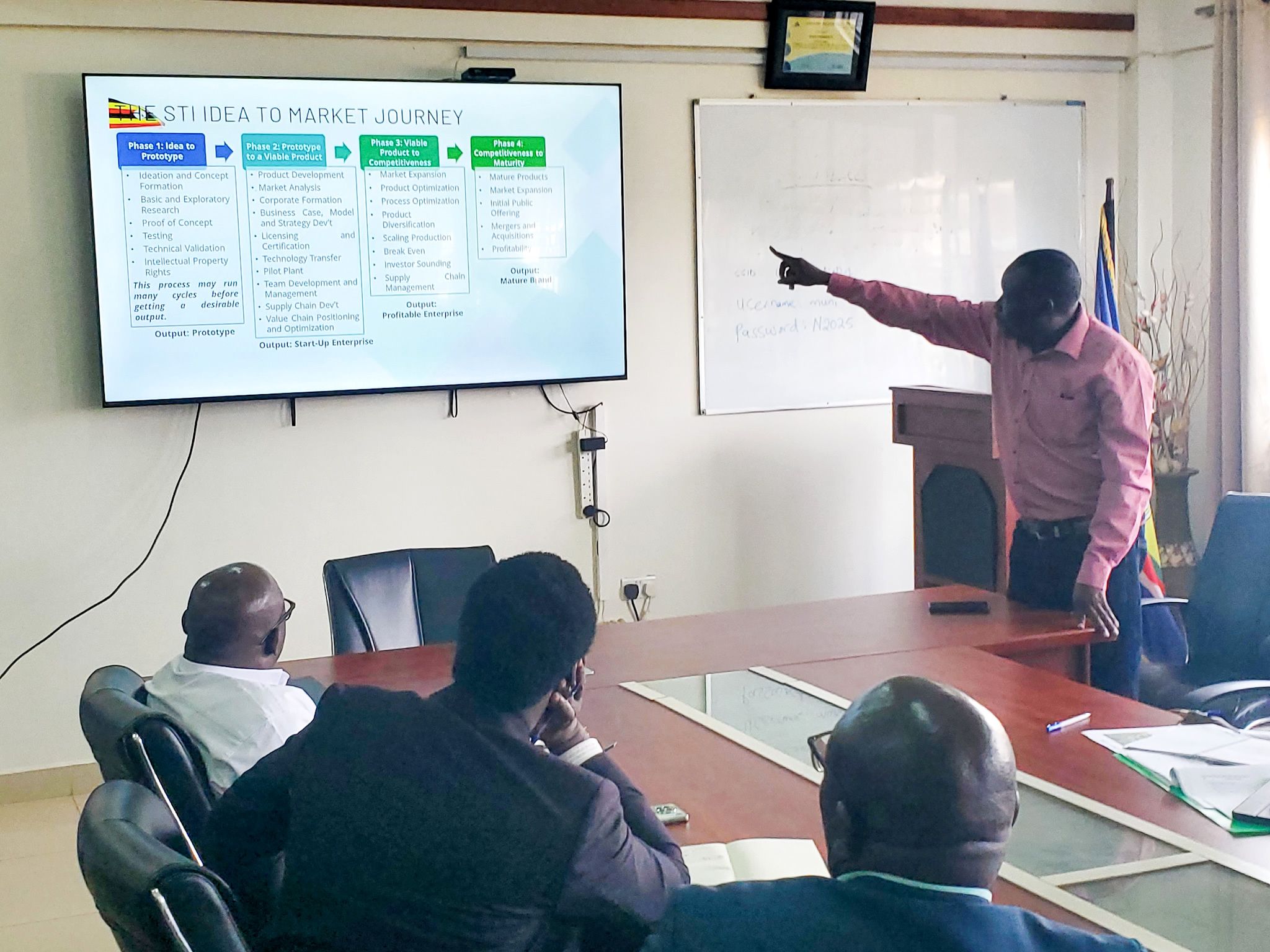
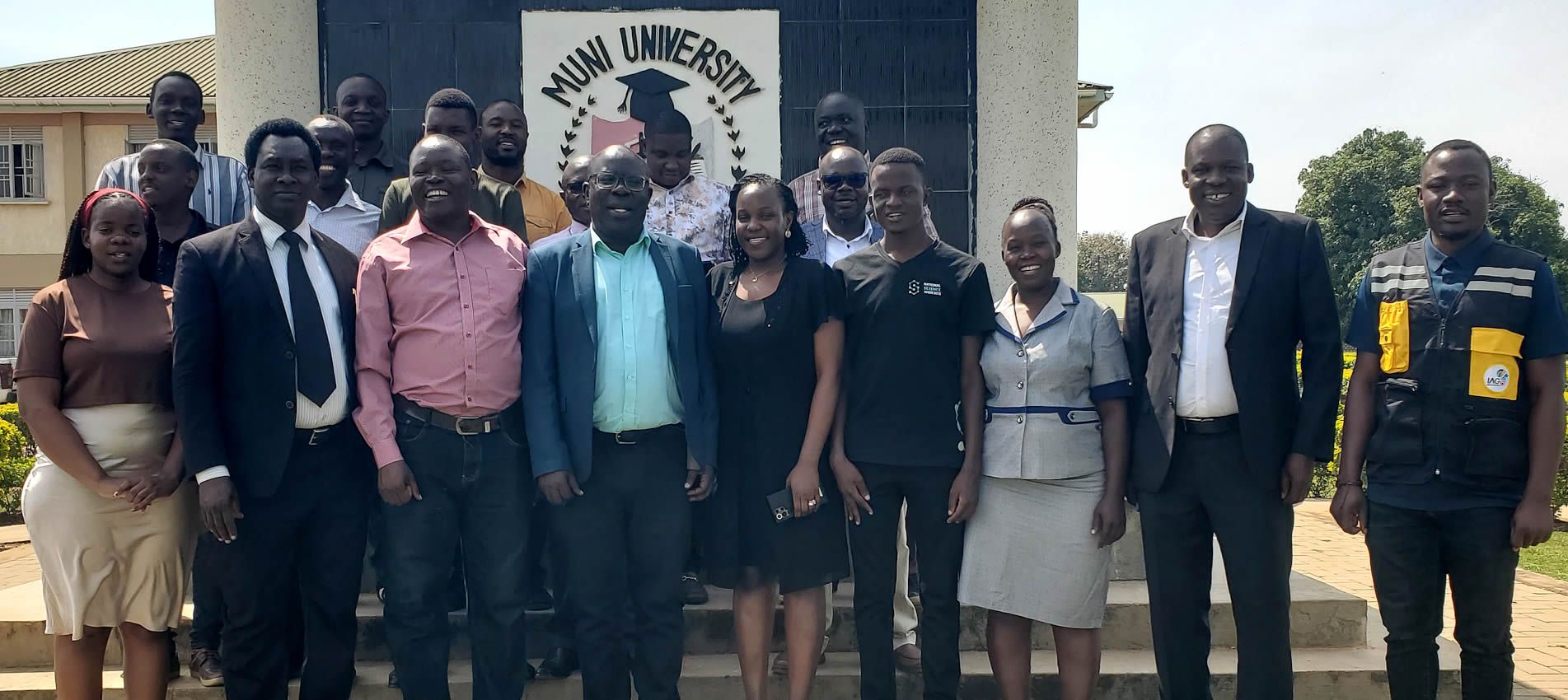
Muni University in Arua has warmly welcomed a delegation from the Science, Technology and Innovation Secretariat (STI-OP) under the President’s Office, marking a key step towards establishing West Nile’s first Agro-Science Industrial Park. The delegation was received by Prof. Jacob Agea, Deputy Vice Chancellor Academic Affairs, representing the Vice Chancellor, Prof. Robert Kajobe, University Secretary, and Prof. Clement Okia, Deputy Director of the Directorate of Research and Training, alongside other senior university officials.
The meeting was convened to brainstorm guidelines for integrating Muni University into the national STI framework and to discuss how the university can lead the development of the Agro-Science Industrial Park in West Nile.
Prof. Jacob Agea, Deputy Vice Chancellor Academic Affairs, who represented the Vice Chancellor, expressed the university’s readiness to collaborate with the STI Secretariat. He highlighted Muni University’s extensive land holdings across West Nile as potential sites for the industrial park, including 439.58 hectares at Yumbe, 147.17 at Pakwach, 2,597.08 at Maadi Okollo, 0.44 in Arua, 133 in Ayivu, 82 in Moyo, and 20 hectares recently allocated at Koboko. “Muni University is strategically positioned to champion this project,” he said.
Mr. Eric Mwima, Principal Programs Officer, STI Secretariat, emphasized the vision for the park:
“This initiative will transform graduates into industry-ready professionals and stimulate economic growth in West Nile. Muni University’s strategic location and commitment to innovation make it the ideal partner.”
The STI delegation stressed that the park would function as a “common user facility”, where students and staff could engage in hands-on research, industrial-scale production, and value chain analysis. They also highlighted the park’s role in enhancing local value addition, noting that agricultural produce collected from farmers will be processed into market-ready products within the university-led facility, creating employment and reinforcing Muni University’s position as a hub of innovation and industry.
Prof. Robert Kajobe, University Secretary, highlighted the region’s potential for agricultural innovation, citing its robust production of cassava, sesame, cocoa, and shea butter. He underlined that the university is uniquely positioned to not only conduct research but also integrate value addition and industrial processing, creating a bridge between science and practical enterprise.
Prof. Clement Okia, Deputy Director of the Directorate of Research and Training, emphasized the university’s strategic regional location:
“Muni University is at the crossroads of four countries: the Democratic Republic of Congo, South Sudan, the Central African Republic, and near the borders of West Africa. This gives us a unique advantage to lead regional innovation initiatives. With our available land, research facilities, and dedicated staff, we are ready to champion the Agro-Science Industrial Park, not just as an academic and research hub, but as a center for industrial value addition and cross-border economic growth.”
To formalize the partnership, the STI Secretariat requested documentary approvals, including confirmation of allocated land, a minute of University Council approval, and copies of the relevant land titles. The university confirmed that 300 acres will be allocated for the project, ensuring sufficient space for research, teaching, and industrial activities.
The STI delegation emphasized that the park would help graduates find employment, transform Muni University into an industry hub beyond academics, and provide students and staff with access to cutting-edge facilities for hands-on learning and research. They stressed the importance of university-led innovation in solving local industrial challenges and supporting regional industries in West Nile.
With its Business Incubation Centre, well-equipped staff, and strategic regional position, Muni University is set to redefine the role of higher education in Uganda, moving beyond knowledge sharing to industrial leadership and community transformation.
“Transforming lives remains our guiding motto,” said Prof. Kajobe. “Through this partnership, Muni University will harness science, technology, and innovation to drive economic and social progress in West Nile and beyond.”