
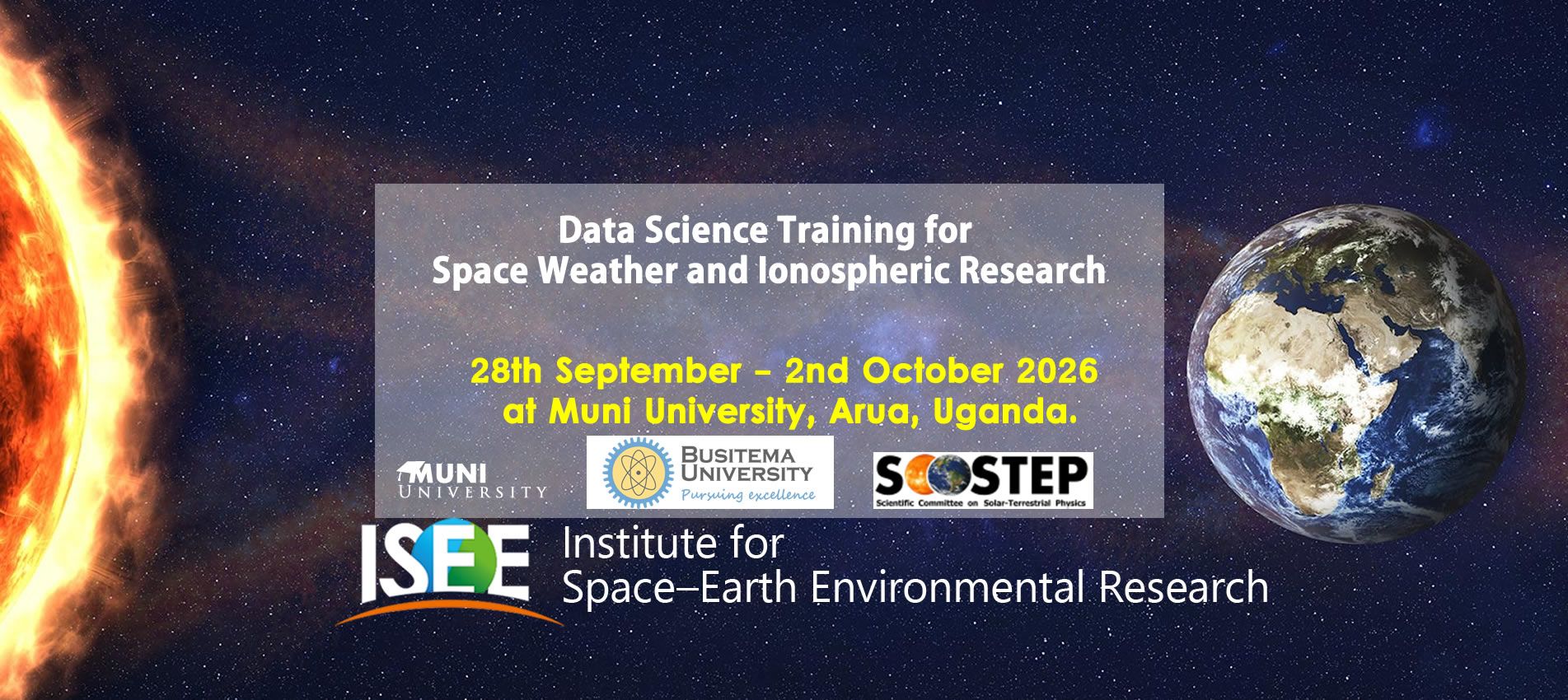
(a) Description of the planned activity
This workshop focuses on the application of data science techniques to understand Space Weather phenomena and the ionosphere. Understanding these phenomena requires the analysis of vast amounts of observational data. One of the data sources for studying the ionosphere comes from the Global Navigation Satellite Systems (GNSS) which can measure the total electron content (TEC) in the ionosphere, enabling researchers to monitor and model space weather effects. The training is scheduled to last for five days during 28th September - 2nd October 2026. On the first day, the lecturers will review basic topics in space weather and ionospheric science. The second day will cover principles of GNSS. The topics that will be covered shall include, satellite orbits, signals and observables as well as satellite data processing. On the third day, participants are taught on the principles of extraction of ionospheric TEC from GNSS observables usually provided in Receiver Independent Exchange (RINEX) data files. Moreover, the students will be taught how to obtain satellite orbit parameters from RINEX navigation files. The satellite orbit parameters will be used to map the TEC obtained from RINEX observation files. On the fourth day, participants are divided into groups and assigned tasks to extract TEC data from GNSS observables in RINEX files during various space weather conditions as depicted by Disturbance storm time (Dst) index and Kp index. On the morning of the fifth day, participants present and discuss their findings. The lecturers assess the student presentations in order to determine the success of the workshop. The workshop will end with panel discussions on the way forward.
(b) Dates and Venue of the workshop
The training is scheduled for 28th September - 2nd October 2026 at Muni University, Arua, Uganda.
Interested persons should submit applications before 30th July 2026 using the link below:
(c) Contact Information
The contact person is Assoc. Prof. Patrick Mungufeni (This email address is being protected from spambots. You need JavaScript enabled to view it. / This email address is being protected from spambots. You need JavaScript enabled to view it.), Head of Physics department at Muni University.
(d) Funding of participants
There is limited funding to support successful applicants from the East African Community member states.
(e) The list of sponsors
1. Muni University
2. The Scientific Committee on Solar-Terrestrial Physics
3. Busitema University
4. Institute for Space-Earth Environmental Research