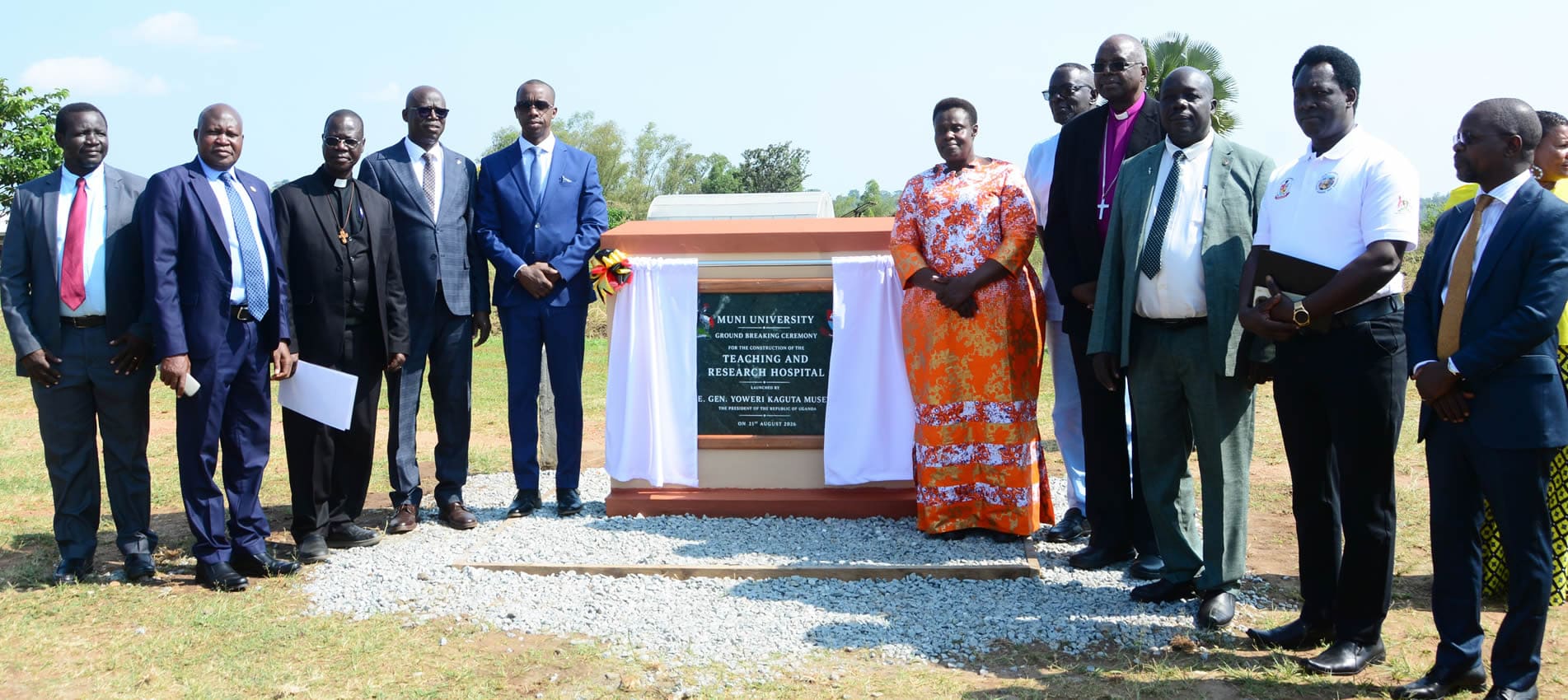
Muni University, Arua City has opened a new chapter in healthcare and higher education in Uganda’s West Nile region, breaking ground for its much-anticipated World Class Teaching and Research Hospital, a landmark project expected to transform medical education, specialised healthcare, research and innovation across the region and beyond.
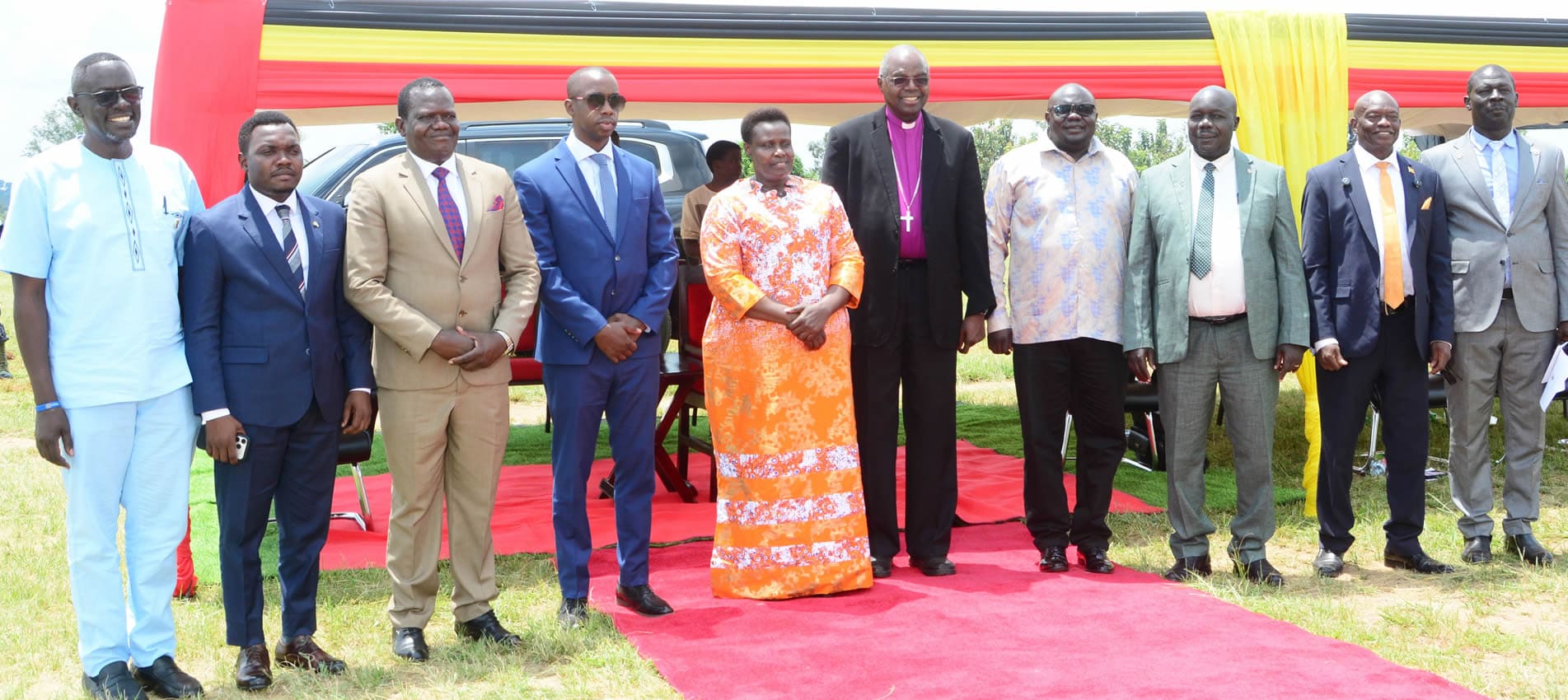
The historic ceremony at Muni University’s Main Campus on Friday, 21 August 2026, brought together senior Government officials, university leaders, Members of Parliament, local government authorities, cultural leaders, academics, technical experts and members of the community, with President Yoweri Kaguta Museveni represented by Vice President Jessica Alupo as Chief Guest.
For Muni University, the occasion represented far more than the beginning of a construction project. It marked the realisation of a long-held institutional ambition to establish a major academic health facility where students can acquire practical clinical experience, researchers can develop solutions to pressing health challenges and communities can access increasingly specialised medical services closer to home.
The project is also expected to strengthen Muni University’s growing identity as a centre of excellence in Science, Technology, Engineering, Mathematics and Health Sciences, while reinforcing Arua City’s emerging position as a strategic regional hub for education, healthcare, research, trade and investment.
Muni University has described the hospital as one of the most significant developments in its history. The university had earlier announced that Government had committed substantial funding towards the project and that construction would be undertaken by Roko Construction Company Limited, with the facility expected to combine healthcare delivery, medical training, research and innovation.
President Museveni: Hospital to Bring Specialised Healthcare Closer to the People
In a speech delivered by Vice President Jessica Alupo, President Museveni congratulated the Muni University community upon reaching the historic milestone and described the Teaching and Research Hospital as an important component of the university’s continuing expansion.
The President said the proposed facility would bring together four critical functions: health service provision, training, research and innovation, making it much more than a hospital but conventional healthcare facility.
He placed the project within the broader history of Uganda’s higher education transformation, noting that Government’s decision to establish regional public universities was intended to expand access to higher education and respond to the development needs of different parts of the country. Muni University, he said, emerged from this vision as an institution established to contribute to the socio-economic transformation of West Nile and Uganda as a whole.
President Museveni commended Muni University for the progress it has made since its establishment, particularly the growth in student enrolment, expansion of academic programmes, increased emphasis on Science, Technology, Engineering and Mathematics, research output and community engagement.
He specifically recognised the University’s Refugee and Host Community Youth Empowerment Initiative, while also congratulating Muni University for being among the five African universities to receive the inaugural Laureate of Africa Higher Education for Transformation Prize.
The President said the Teaching and Research Hospital represents another major step in Muni University’s expansion and will bring healthcare services closer to the people while creating a stronger environment for training health professionals, conducting research and developing innovations.
He further commended the university for developing an ambitious architectural plan and broadening the range of services that will be available to the people.
Importantly, President Museveni reiterated Government’s commitment to financing the construction and provision of equipment for the Teaching and Research Hospital, emphasising its potential to reduce the economic burden associated with medical tourism, as Ugandans currently travel abroad in search of specialised treatment.
The President also encouraged parents, particularly those from West Nile, to send their children to Muni University and urged young people to consider science and technology-related programmes that can strengthen their employability and contribution to the private sector.
His message placed the hospital within a much wider national agenda: expanding access to quality healthcare, producing a stronger health workforce, retaining resources within Uganda and using higher education as an engine of socio-economic transformation.
Vice President Alupo: Muni University Has Grown From a Seed Into a Regional Institution
Vice President Jessica Alupo, who represented the President at the ceremony, described Muni University as a Government investment and a lasting gift to the people of West Nile.
“Muni University is a Government investment and a lasting gift to the people of West Nile. What we are witnessing today is evidence of how this institution has grown and the important role it continues to play in the development of this region,” Vice President Alupo said.
Reflecting on her previous visits to the university, she recalled planting a tree on campus and expressed gratitude that the tree continues to flourish, drawing a parallel between its growth and the development of Muni University itself.
“I remember coming here and planting a tree. I am grateful that the tree is still growing. In many ways, its growth reflects the journey of Muni University, which has also continued to grow from a small beginning into an important regional institution,” she said.
She paid tribute to the founding vice chancellor of Muni University,the late Professor Christine Dranzoa and other leaders like The Very Rev. Fr. Prof. Epiphany Odubuker Picho current Vice chancellor incharge of Finance and Administration, whose determination contributed to the establishment of a public university in West Nile.
“We must recognise the contribution of the late Professor Christine Dranzoa and other leaders who worked tirelessly to see a public university established in West Nile. Their determination laid an important foundation for the institution we see today,” Alupo said.
The Vice President further acknowledged the concerns and proposals raised by Members of Parliament and other political leaders during the ceremony, saying the issues would be compiled into a report for presentation to President Museveni.
“I have listened carefully to the concerns and proposals that have been raised by our leaders today. These issues will be compiled and presented to His Excellency the President for consideration,” she said.
Among the concerns raised were infrastructure, road connectivity, land for university expansion and the need to strengthen Muni University’s staffing levels.
Responding to the university’s request to increase staffing, particularly academic staff, Alupo pledged to support efforts to lobby the Ministry of Education and Sports and the Ministry of Finance Economic Development because a growing university must have adequate staff to maintain the quality of education,”, Planning and Economic Development.
“On the issue of staffing, particularly academic staff, I will support the university in engaging the Ministry of Education and Sports and the Ministry of Finance, Planning and she said.
She said strengthening staffing would be important in maintaining the quality of education as the university continues to expand its academic programmes and enrolment.
The Vice President also addressed concerns about transport infrastructure around Arua and West Nile, saying Government had plans for the Nebbi-Arua road, with a feasibility study already undertaken and a contractor expected to commence work.
“Government has already undertaken the feasibility study for the Nebbi-Arua road, and we expect a contractor to commence work. Improved connectivity will be important for the development of Arua and the wider West Nile region,” Alupo said.
She further said Government was pursuing the Goli-Zombo-Vurra road, noting that a Chinese company had been contracted to undertake the project.
“We are also pursuing the Goli-Zombo-Vurra road, and a Chinese company has been contracted to undertake the project. These roads will improve connectivity and support economic activity in the region,” she added.
Alupo said improved road infrastructure would complement major investments such as the Muni University Teaching and Research Hospital by making it easier for patients, students, professionals and businesses to access the region.
“A hospital of this magnitude must be supported by good infrastructure. Better roads will make it easier for patients, students, health professionals and businesses to access Muni University and the wider region,” she said.
She also used the occasion to urge communities to remain vigilant against Ebola and other infectious diseases, particularly along the Uganda DRC border, and encouraged mothers to ensure their children receive immunisation, eat balanced diets and sleep under treated mosquito nets.
“I urge our communities, particularly those along the Uganda DRC border, to remain vigilant against Ebola and other infectious diseases. Mothers should ensure that children are immunised, receive balanced nutrition and sleep under treated mosquito nets,” she said.
Her message reinforced the broader purpose of the hospital, emphasising that healthcare infrastructure must be supported by prevention, public awareness, trained health workers, strong infrastructure and sustained Government investment.
Vice Chancellor: Hospital Marks a Defining Moment in Muni University’s Transformation
Muni University Vice Chancellor, Associate Professor Simon Anguma Katrini, described the groundbreaking as one of the most important moments in the institution’s history and expressed appreciation to President Museveni for his continued support towards Muni University.
“Today marks a defining moment in the history and transformation of Muni University. We are grateful to His Excellency President Yoweri Kaguta Museveni for the support and commitment that have enabled this university to grow from its formative years into an institution serving the people of West Nile and beyond,” Associate Professor Anguma said.
Associate Professor Anguma said the story of Muni University could not be told without recognising the President’s role in its establishment and growth, noting that the institution had benefited from his interest and support from its formative years.
He thanked the President for being represented by Vice President Alupo and commended her for what he described as her continued support towards the development of Muni University.
“We are equally grateful to Her Excellency the Vice President, Jessica Alupo, for representing the President and for her continued support towards the development of Muni University,” he added.
The Vice Chancellor further thanked ministers, Members of Parliament, local government leaders, heads of Government agencies and departments, representatives of sister universities and other stakeholders for joining the university during what he described as a monumental occasion.
“We appreciate the presence of Government leaders, Members of Parliament, local government leaders, heads of Government agencies and departments, our sister universities and all our partners and stakeholders who have joined us on this important occasion,” Associate Professor Anguma said.
He said the establishment of Muni University was a strategic Government decision that has continued to drive social and economic transformation in West Nile and beyond.
“The establishment of Muni University was a strategic decision by Government, and the university has continued to contribute to the social and economic transformation of West Nile and the country at large,” he said.
Associate Professor Anguma particularly highlighted the significance of the planned Teaching and Research Hospital alongside the proposed development of facilities associated with the Uganda Cancer Institute and Uganda Heart Institute on the university campus.
He said these developments have the potential to transform Muni University into an integrated ecosystem bringing together specialised healthcare, medical education, research, innovation and professional services.
“The Teaching and Research Hospital, together with the proposed developments associated with the Uganda Cancer Institute and Uganda Heart Institute, will create an integrated environment where healthcare, medical education, research and innovation can grow together,” he said.
The Vice Chancellor also used the occasion to demonstrate how far Muni University has travelled since its establishment. From its early beginnings, the university has expanded to six faculties, 34 academic programmes and approximately 310 staff, with plans for further growth.
“From where we started, Muni University has made significant progress. Today, we have six faculties, 34 academic programmes and approximately 310 staff, and our ambition is to continue expanding in response to the needs of our people,” Associate Professor Anguma said.
He said rising enrolment and demand for higher education were creating pressure for additional academic space and infrastructure, and appealed to Government to support the university in securing additional land, including Balifa Forest, to facilitate its long term expansion.
“As the university continues to grow, we are experiencing increasing demand for academic space and infrastructure. We therefore appeal to Government to support us in securing additional land, including Balifa Forest, so that we can plan effectively for the university’s future expansion,” he said.
Associate Professor Anguma said Muni University’s growth trajectory would continue, with ambitions to expand enrolment to approximately 7,600 students within the next five years and increase the number of academic programmes significantly in the coming years.
“Our vision is to grow our student population to approximately 7,600 within the next five years and significantly expand our academic programmes so that Muni University can respond to the growing demand for higher education,” he added.
He assured the gathering that the Teaching and Research Hospital would become a critical pillar in advancing medical education and healthcare delivery, enabling Muni University to deepen its contribution to Uganda’s health sector.
“This Teaching and Research Hospital will be a critical pillar in our mission to advance medical education, research and healthcare delivery. It will enable us to produce highly skilled health professionals and deepen Muni University’s contribution to Uganda’s health sector,” Professor Anguma said.
Muni University had earlier explained that the hospital is central to its ambition to expand advanced health training, including the development of additional medical programmes, because modern medical education requires access to appropriate clinical infrastructure and a strong teaching environment.
Council Chairman’s Remarks: A New Promise for Healthcare in West Nile
The Chairman of Muni University Council, Eng. Joel Aita, delivered a powerful message at the historic groundbreaking ceremony, describing the Teaching and Research Hospital as more than a construction project, but a promise of better healthcare, stronger medical education and greater opportunities for the people of West Nile.
He told the gathering that the groundbreaking was laying the foundation for a future in which a child born in West Nile could grow up with access to a standard of medical care comparable to that available in Kampala, Nairobi and other leading cities around the world.
“Today the soil of Arua City receives more than a foundation stone. It receives a promise, a promise that the child born tonight in West Nile will grow up within reach of the same standard of medical care as a child born in Kampala, Nairobi or London.”
Eng. Aita emphasised that the Muni University Teaching and Research Hospital should not be viewed as an ordinary hospital, but as an integrated academic health system linking healthcare delivery directly with medical education, research and innovation.
He explained that the planned facility will provide an environment where health sciences students can gain practical experience within modern wards, theatres and laboratories while researchers pursue solutions to the region’s pressing health challenges.
“The Muni University Teaching and Research Hospital is conceived as an integrated academic health system, a 200 bed tertiary and quaternary referral hospital, physically and academically fused with the Muni University Medical School.”
The Council Chairman further outlined the broader ambition behind the project, saying the hospital is intended to promote health, prevent disease, cure illness, rehabilitate patients and strengthen accurate diagnosis.
He said the hospital’s impact would extend beyond Arua City because of West Nile’s geographical position and its links with South Sudan, the Democratic Republic of Congo and the wider region.
Eng. Aita said Muni University’s ambition is to develop a facility capable of meeting international standards and producing health professionals who can confidently work in leading medical institutions anywhere in the world.
He illustrated that ambition through an international comparison, saying Muni wants the quality of its hospital facilities, systems and care to be sufficiently high that students and professionals coming from leading global universities would find the environment familiar.
“We envisage a hospital of such standard that if a medical student from Harvard University or the University of Oxford were to walk into these wards on exchange, they would find the same quality of facilities, systems and care they left behind and feel at home.”
Eng. Aita also highlighted the potential of the hospital to reduce the number of Ugandans travelling abroad in search of specialised medical treatment, thereby helping retain financial resources within the country.
He called for Government to support not only the construction of the hospital but also its long term operations, including staffing, medicines, equipment maintenance and other systems necessary for sustained service delivery.
The Council Chairman further proposed that Muni University pursue strategic international partnerships to strengthen specialist healthcare, hospital management systems, technology, clinical standards and international referral networks.
He challenged the project team to ensure that the hospital is constructed to the highest professional standards and urged the institution to pursue internationally recognised accreditation so that its quality can be independently assessed and verified.
Beyond healthcare, Eng. Aita said the hospital could stimulate a wider economic ecosystem around Arua City and West Nile, creating opportunities in medical research, pharmaceuticals, biomedical technology, specialist training, hospitality and employment.
He concluded by placing the significance of the groundbreaking in human and national terms, saying the project ultimately belongs to the patients who will be treated, the students who will be trained and the country that stands to benefit from stronger domestic healthcare capacity.
Chancellor’s Charge: Build Muni University Teaching Hospital to the Highest International Standards
The Chancellor of Muni University, The Most Rev. Henry Luke Orombi, Retired Archbishop of the Church of Uganda, has called on the university management, project team, consultants and contractors to deliver the Teaching and Research Hospital to the highest professional standards, saying the facility must become a centre of excellence whose quality is demonstrated, independently verified and trusted by every patient who walks through its doors.
In a strong message at the historic groundbreaking ceremony, the Chancellor said the construction of the hospital should be approached with the highest sense of responsibility because the lives and wellbeing of future patients would ultimately depend on the quality of the facility.
“Build this hospital to the highest standard known to the profession.”
He urged those responsible for delivering the project to treat every component of the hospital, from its theatres and laboratories to oxygen systems and drainage infrastructure, with the same care and precision they would demand if the lives of their own families depended on it.
The Chancellor further challenged the project team not merely to complete the building, but to prove its quality through internationally recognised standards and accreditation.
He called for the hospital to pursue international certification, including accreditation by the Joint Commission International, so that the institution’s standards would not simply be proclaimed but independently assessed and verified.
He said such accreditation would give patients, health professionals, students, researchers and international partners confidence that the hospital operates according to globally recognised standards of quality and patient safety.
The Chancellor also looked beyond the physical construction of the facility, highlighting the wider economic and social transformation that could emerge around the hospital.
He said the development could stimulate an entire health ecosystem encompassing medical research, pharmaceuticals, biomedical technology, specialist training, hospitality and employment, creating opportunities for young people while strengthening Arua City and the wider West Nile economy.
He thanked President Yoweri Kaguta Museveni, represented at the ceremony by Vice President Jessica Alupo, together with the Government of Uganda, Parliament, development partners, political and community leaders, and the people of West Nile for supporting the realisation of the project.
He also recognised the University project team and other stakeholders who now carry the responsibility of turning the vision into a completed and fully functional institution.
The Chancellor said the significance of the groundbreaking should ultimately be measured by the lives transformed through the hospital.
He emphasised that the foundation being laid was not simply for a building, but for patients who will receive treatment, students who will receive practical training, researchers who will generate new knowledge and a country that can retain more of its healthcare capacity and resources at home.
His message ended with a call for the project to become a lasting symbol of excellence, service and national transformation.
“The ground we break today, we break for the sick who will be healed here, for the students who will be trained here, and for the nation whose money and whose dignity will be kept at home because of what rises here.”
Arua City Mayor: Hospital Can Accelerate Skills, Jobs and Urban Growth
Arua City Mayor, His Worship Lawrence Alionzi, said the project represented an important opportunity for the city’s young people, particularly through skills development, employment and new economic activities that are expected to emerge around the hospital.
He expressed confidence that Muni University, working together with Government, the contractors and other stakeholders, would deliver a facility befitting Arua City and the wider West Nile region.
The Mayor also pledged his support towards efforts to secure additional land, including Balifa Forest, to enable Muni University to respond to its growing demand for academic and physical infrastructure.
He linked the hospital to Arua City’s wider strategic position as a growing urban centre and said the development of major institutions such as Muni University could contribute significantly to the city’s future as a regional hub.
“This hospital is an important opportunity for our young people. It will create opportunities for skills development, employment and new economic activities around the facility,” Mayor Alionzi said.
He added that the project would strengthen Arua City’s position as a regional centre, saying, “As Arua continues to grow, major institutions such as Muni University will play an important role in shaping the city’s future as a regional hub.”
The Mayor further expressed confidence in the university’s partnership with Government and other stakeholders to deliver a facility that would serve the needs of Arua City and the wider West Nile region.
Ayivu East MP-Hon. Tiyo William: Let Communities See the Value of Muni University
The Member of Parliament for Ayivu East in Arua City, Hon. Tiyo William, said local communities have an important role to play in ensuring that Muni University continues to fulfil its mandate.
“Our communities need to understand and appreciate the value of Muni University and what it is contributing to the development of our people, particularly through practical education and skills development,” Hon. Tiyo William said.
He said the people of West Nile should increasingly appreciate the relevance of Muni University because of its contribution to practical education and skills development.
He emphasised that the Teaching and Research Hospital would strengthen this mission by creating a stronger environment where health sciences students can connect classroom learning with practical clinical experience.
“The Teaching and Research Hospital will give our students an opportunity to move beyond the classroom and gain practical clinical experience. This is important for producing graduates who are ready to serve our communities,” he added.
For communities surrounding the university, he said the project should therefore be seen not only as a healthcare investment but also as an educational and economic opportunity capable of creating new pathways for young people.
“This is not only a hospital for treating patients. It is also an investment in education, skills and the future of our young people. The community should see and embrace the opportunities that this project will bring,” Hon. Tiyo William said.
Government: Project Must Deliver Value and Accountability
Representing the Minister of Education and Sports, Hon. Dr J.C. Muyingo, congratulated Muni University for reaching the groundbreaking milestone and described the Teaching and Research Hospital as a major centre for healthcare service delivery, research and professional training.
He said the project had generated significant hope among communities and leaders in West Nile and reminded the university that Government would expect the institution to maintain competent curricula and high academic standards.
Dr Muyingo also emphasised the importance of integrity in project implementation, assuring the gathering that Government would maintain attention to accountability and that corruption should not be tolerated in the project.
The message was particularly significant given the scale of the investment: the hospital is expected to require substantial public resources, making transparency, quality control and proper project management central to its successful delivery.
Dr Ayume: Infrastructure Must Support the Hospital
Minister of State for Primary Health Care and Member of Parliament for Koboko Municipality, Hon. Dr Charles Ayume, described the project as a source of hope for the people of West Nile.
He emphasised that a modern hospital cannot operate effectively without the supporting infrastructure required to sustain advanced medical services.
He therefore thanked the Government and other stakeholders responsible for strengthening peace, electricity connectivity and road infrastructure in the region, noting that sophisticated medical equipment requires reliable power while patients and supplies must be able to reach the facility efficiently.
His message highlighted an important reality surrounding the project: the success of the Teaching and Research Hospital will depend not only on the building itself but also on the wider infrastructure and systems supporting healthcare delivery.
Minister Aza Alero: Healthy People Are the Foundation of Development
Minister of State for Trade, Industry and Cooperatives, Hon. Tom Aza Alero, linked the hospital directly to Uganda’s national development agenda.
He said meaningful development cannot be achieved without a healthy population because healthy bodies support healthy minds and productive communities.
He argued that human beings are among the country’s most important resources and therefore deserve investment in healthcare, education and skills.
The Minister connected the project to the National Development Plan IV, the Sustainable Development Goals and Uganda’s economic transformation agenda, stressing that healthier citizens are better positioned to participate in productive economic and national development activities.
For him, the Teaching and Research Hospital therefore represents an investment not only in healthcare but also in Uganda’s human capital and future economic productivity.
A Project Designed for Major Impact
According to Muni University Head of Estates, Engineer Willy Ocen, the Teaching and Research Hospital is planned as a multi-phase development with modern facilities, equipment and supporting infrastructure.
He told guests that the project would be implemented in phases, with the first phase estimated at approximately UGX 182.5 billion according to the project presentation made during the ceremony.
He said Roko Construction Company Limited would undertake the construction, with the implementation period expected to run for approximately 30 months.
Engineer Ocen said the project land is available and free from encumbrances and that the hospital will be fully funded by the Government of Uganda.
He explained that supervision would be undertaken by a consultant team reporting to university management, with participation from relevant Government institutions including the Ministry of Works and Transport, Ministry of Health and Arua City authorities.
He added that professional stakeholders from West Nile, including engineers, lawyers and political leaders, would also participate through site visits and oversight.
Muni University’s pre-groundbreaking publications have similarly identified Roko Construction Company Limited as the contractor and described the hospital as a major Government-backed investment intended to strengthen healthcare, medical education, research and innovation.
More Than a Hospital: Muni’s Next Transformation
The significance of the groundbreaking extends beyond the physical structure that will rise on the university campus.
The Teaching and Research Hospital is expected to become the clinical backbone of Muni University’s growing health sciences agenda, providing a platform for practical training, specialist education, research partnerships and innovation.
The university has already indicated that the facility is expected to host a wide range of modern clinical, teaching and research services, including advanced laboratories, operating theatres, intensive care services, radiology, dialysis, specialised clinics and other supporting facilities.
It is also expected to strengthen collaboration with major health and research institutions, creating opportunities for knowledge exchange and joint research.
Muni University’s leadership has previously highlighted engagement with institutions including the Uganda Cancer Institute and other health research partners as part of the university’s broader ambition to build a stronger health and scientific ecosystem.
For West Nile, the hospital represents the prospect of specialised healthcare closer to home.
For Muni University, it represents the infrastructure needed to expand advanced health sciences training.
For Uganda, it represents another opportunity to strengthen the national health workforce, retain more patients within the country and expand domestic capacity for medical research and innovation.
A Historic Foundation for Muni University’s Future
As the groundbreaking ceremony came to a close, the significance of the day extended well beyond the speeches, ceremonial activities and foundation works.
For Muni University, the moment represented the convergence of years of institutional growth, Government investment, community support and an increasingly ambitious vision for the future.
From a university established to respond to the educational and development needs of West Nile, Muni is now positioning itself to become a major centre for healthcare, medical education, research and innovation.
The Teaching and Research Hospital will stand at the heart of that transformation.
The message from Government, University leadership and political leaders was broadly united: the project must be completed to a high standard, properly equipped, adequately staffed and sustained as a centre of excellence capable of serving West Nile, Uganda and the wider region.
And as construction begins, the promise made at the groundbreaking is now moving from the speeches to the ground a promise of stronger healthcare, better clinical training, deeper research, greater innovation and a new chapter in the story of Muni University as a catalyst for transformation in West Nile and Uganda.
For Muni University, the groundbreaking was not simply the laying of a foundation. It was the laying of a new foundation for the future of medical education, specialised healthcare and scientific research in West Nile.