
|
Muni University is strengthening its contribution to youth employment, renewable energy development and sustainable livelihoods in Greater Northern Uganda through its partnership with the German Agency for International Cooperation (Deutsche Gesellschaft für Internationale Zusammenarbeit, GIZ). Through this collaboration, the University launched a Short Course in Renewable Energy Skills Development, leading to a Certificate in Solar Design and Installation, aimed at equipping young people with practical, industry-relevant competencies in solar energy design, installation, maintenance and innovation. In 2026 June to July, the University, in collaboration with GIZ, recruited the first cohort of 60 |
|
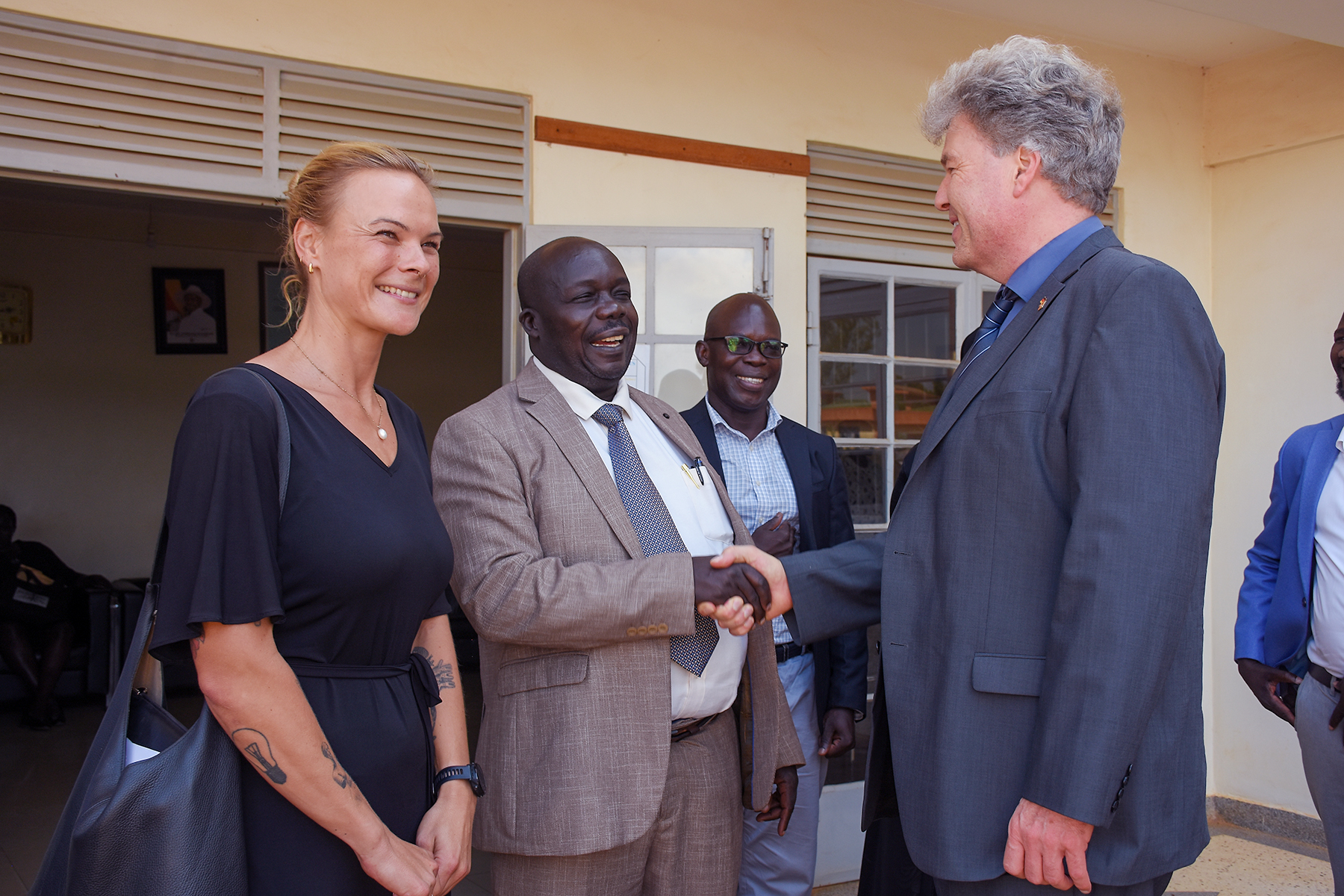
youth, who underwent five weeks of practical training in solar installation and maintenance and were subsequently awarded certificates. The programme forms part of Muni University's broader commitment to addressing youth unemployment by bridging the gap between academic training and labour market demands, while strengthening employability in the growing green energy sector. Beyond renewable energy skills development, Muni University and GIZ are working on other collaborative initiatives, including leadership capacity building for local governments to strengthen leadership and governance through the University's newly launched Institute of Leadership and Governance. Against this background, the Vice Chancellor, Assoc. Prof. Simon Anguma Katrini, on Wednesday, 4 November 2026, hosted a German delegation led by the German Ambassador to Uganda, H.E. Sigrid Sommer, and Joachim Schhmit, Head of the Central and East African Division at Germany's Federal Ministry for Economic Cooperation and Development (BMZ). |
The delegation visited Muni University's Main Campus in Arua City as part of a region-wide monitoring and evaluation exercise of German-supported projects in West Nile. Given Muni University's ongoing partnership with GIZ in youth skilling in solar installation and other projects, the delegation sought to monitor and assess the impact of the GIZ-supported solar installation project on its beneficiaries.
During the visit, the trainees demonstrated their practical competencies in the solar design, installation and maintenance , showcasing the knowledge and skills acquired through the programme. They also shared personal experiences of how thetraining had equipped them with livelihood skills and enabled them to transition into dignified employment.
Dr. Opio Innocent Miria, Head of the Department of Mechanical and Materials Engineering (MEME) and GIZ–Muni University Liaison Coordinator,explained that the University’s approach goes beyond providing technical training to connecting graduates with ponential employers.
The Vice Chancellor, Assoc. Prof. Simon Anguma Katrini, commended the partnership, noting that the initiative directly responds to Uganda's youth unemployment challenge by promoting hands-on, industry-relevant skills and strengthening employability in the growing green energy sector.
Sharing his personal experience of the programme’s impact, he revealed that one of the trainee had successfully repaired the solar systems at his residence which had been non-functional for a considerable period
"This demonstrates the practical value of the skills we are imparting to our young people. When a trainee can apply the knowledge acquired to solve real-life challenges, it shows that the programme is making a meaningful difference beyond the classroom," he said.
The German Ambassador to Uganda, H.E. Sigrid Sommer, commended the collaboration between GIZ and Muni University, emphasising the importance of equipping young people with practical skills that respond to the needs of communities and the labour market.
"Germany values partnerships that translate development cooperation into tangible improvements in people's lives. Seeing young people acquire practical renewable energy skills and use them to create employment opportunities demonstrates the importance of investing in skills development and sustainable livelihoods," she said.
The Head of the German Delegation, Joachim Schhmit, Head of the Central and East African Division at Germany's Federal Ministry for Economic Cooperation and Development, noted that the monitoring and evaluation exercise provides an opportunity to assess the outcomes of German-supported interventions and understand the impact they are making in communities.
"Our interest is not only in the implementation of projects but also in the results they deliver. Meeting the trainees, listening to their experiences and seeing how they are applying the skills acquired provides valuable insight into the impact of this intervention and the opportunities it is creating for young people," he remarked.
From Training to Practical Solutions: The Beneficiaries' Experiences
For Ronald Ovuga, one of the beneficiaries, the training has equipped him with practical competencies to address renewable energy challenges affecting communities in Northern Uganda. He explained that he can now assess solar energy needs by determining electrical loads and whether they match the capacity and sizing of a solar system, troubleshoot faults, repair systems and undertake routine maintenance.
"The practical technological skills I have developed to address renewable energy challenges affecting our communities have given me the confidence to contribute to electrifying Northern Uganda," he said.
Ronald further encouraged young people in West Nile to consider Muni University for technical training rather than travelling to Kampala, citing the quality of technical skills, hands-on experience, highly skilled trainers, well-equipped practical training materials and innovation- driven partnerships such as the GIZ programme.
He added that Muni University provides young people with an opportunity to understand challenges within their communities and develop practical solutions that directly benefit their people.
Another beneficiary, Evelyne Apolot, shared how the training has transformed her understanding of technology, strengthened her confidence and opened new possibilities for her future.
"Honestly, this opportunity has changed the way I look at technology. Before joining this training, I did not know much about solar installation, but coming here has helped me realise that I can also do technical work. What I love most is that we do not just sit and listen to the instructor. We get the opportunity to touch the equipment and practise by doing the actual work. Even when we have calculations, we do them as part of practical lessons, which makes learning easier for me," she said.
Evelyne recalled an opportunity she had to assist an engineer working at her home, where she participated in wiring, connecting sockets and checking the movement of electrical current. She noted that the training at Muni University had further expanded her knowledge and confidence, helping her discover her interest and ability in technology.
She also shared the challenges she has encountered while pursuing the training, explaining that she currently works as a maid and has had to balance her work responsibilities with learning.
"My journey has not been very easy. I have also faced some challenges as a girl, but I did not allow those challenges to stop me from taking this opportunity. This training has really opened my eyes. It has made me realise that I can do something for myself and build a better future regardless of where I am coming from," she said.
Looking ahead, Evelyne intends to seek opportunities in sales, marketing, designing and assisting experienced engineers to continue gaining practical experience. She also hopes to return to school and pursue further studies in engineering when the opportunity arises.
She expressed her desire to return to her community and encourage other young people, especially girls, to take an interest in technical skills, emphasising that solar installation is not exclusively for men.
"I believe Muni University is helping develop West Nile by giving people practical skills that can create employment and solve challenges in our communities. Personally, I came into this training with challenges, but I am leaving with new knowledge, confidence and a different picture of what my future can look like. Much appreciation to the sponsors and the teachers who gave us the knowledge and skills," she added.
The programme is designed to equip youth in Greater Northern Uganda with practical skills in solar installation, maintenance and renewable energy technologies, addressing the critical gap between academic training and labour market demands. This initiative directly responds to Uganda's youth unemployment challenge by promoting hands-on, industry-relevant skills and strengthening employability in the growing green energy sector.